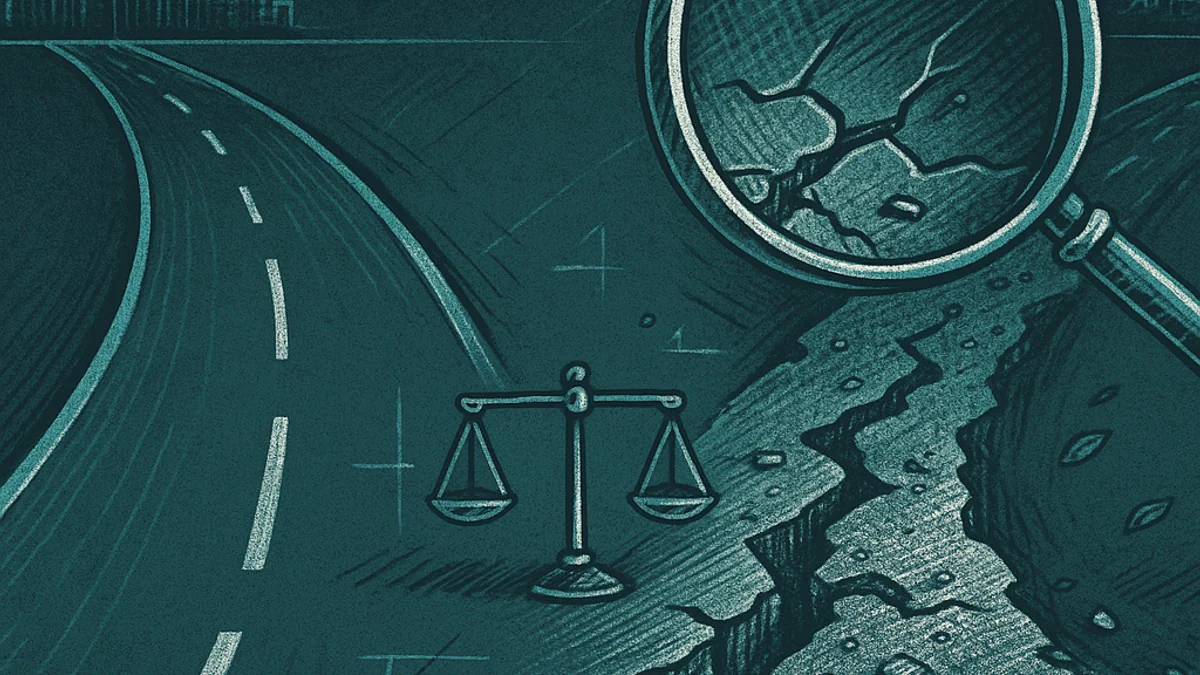
The Bifurcation Under Stress: Five Structural Objections to the Dual-Track Thesis
A systematic challenge to the mimicry-vs-native framing. Where the dual-track model holds, where it fractures, and what the original analysis underweights.
Gemini Deep Research
AI Analysis
Challenges
The Civil War Inside Every Agent
Reading tip: This is an adversarial analysis designed to stress-test ideas. It does not represent the author's position. The goal is intellectual rigor through structured critique.
Executive Summary
“The Civil War Inside Every Agent” proposes a bifurcation in agent architecture: mimicry (training machines to navigate human-designed interfaces) versus machine-native (building purpose-built interfaces for machine consumption). The thesis argues both paths are inevitable, the ratio between them is shifting toward native, and the question is “who adapts to whom?”
This analysis challenges the thesis on five fronts:
- The token economics undermine both paths. The economic case for autonomous agents relies on labor-substitution math that doesn’t hold for the mid-market majority. Neither path is cheap enough for the long tail.
- Protocol standardization creates standardized attack surfaces. The machine-native path assumes security-through-structure, but ClawHavoc demonstrated that standardized protocols scale vulnerabilities as efficiently as they scale capabilities.
- Context compaction breaks both paths equally. LLMs that lose their own instructions during high-volume operations represent a ceiling that no protocol design can fix. The Summer Yue incident is the canonical failure mode.
- Brownfield economics dominate. The greenfield assumption behind dark stores and lights-out manufacturing limits the machine-native path to high-volume, single-domain applications. Most of the world’s infrastructure cannot be rebuilt.
- Human oversight doesn’t scale to machine speed. The “executor-to-shepherd” transition assumes humans can audit machine-speed decisions. In practice, oversight degrades through sampling bias, automation bias, and cognitive fatigue.
Where the thesis holds: The “who adapts to whom?” framing is genuinely useful. The spectrum model (rather than binary choice) captures the reality of hybrid systems. The observation that both paths are expanding simultaneously is well-supported.
Where it fractures: The thesis underweights the economic barriers to both paths, treats protocol fragmentation as a risk rather than a structural impediment, and doesn’t engage with the possibility that the dual-track investment model is itself the bottleneck.
1. The Token-Burn Economic Fallacy
The original thesis treats the mimicry-vs-native choice as primarily architectural. But the economics of both paths challenge the assumption that either is viable at scale for the majority of potential adopters.
1.1 The Variable Cost Problem
The pitch for agentic automation — “one agent replaces ten human workflows” — relies on a labor-substitution model that assumes fixed or declining per-task costs. In practice, agent token consumption is highly variable:
| Scenario | Human Cost | Agent Cost (Tokens) | Agent Cost (USD, est.) |
|---|---|---|---|
| Simple API call | $2/task (junior dev, 5 min) | 2,000 tokens | $0.03 |
| Complex web navigation | $15/task (senior dev, 30 min) | 150,000 tokens | $2.25 |
| Multi-step workflow with error recovery | $50/task (senior dev, 2 hrs) | 500,000-2M tokens | $7.50-$30.00 |
| Always-on monitoring (per hour) | $75/hr (senior engineer) | ~67,000 tokens idle | ~$1.00/hr idle |
The math works decisively for simple, repetitive tasks. It becomes marginal for complex tasks with high error rates. For always-on monitoring — maintaining context, polling state, keeping reasoning warm — the idle cost alone reaches $720/month before the agent does anything interesting.
1.2 The Mid-Market Gap
Enterprise can absorb the token premium: replacing a $15,000/month senior engineer’s repetitive workflows makes the math trivial. But mid-market businesses — the majority of potential adopters — face a different calculation. A $200/month SaaS seat versus $800+ in variable token burn is not a clear win.
This cuts across both paths. Building machine-native interfaces costs engineering time. Running mimicry agents costs tokens. The fork doubles the investment without doubling the return.
1.3 What the Thesis Misses
The original analysis frames the choice as architectural: which path is more elegant, more deterministic, more future-proof. The economic dimension suggests a different framing: which path crosses the affordability threshold first for the majority of businesses? Neither has, and doubling the infrastructure investment across two approaches delays both.
2. The Protocol Security Nightmare
2.1 Standardization as Attack Surface
The machine-native path’s core value proposition is structure: typed contracts, explicit permissions, deterministic execution. The thesis argues this is inherently safer than mimicry’s probabilistic visual reasoning.
But standardized protocols create standardized attack surfaces. When every agent speaks the same protocol, one vulnerability methodology scales across the entire ecosystem.
2.2 The ClawHavoc Precedent
In January 2026, researchers published ClawHavoc — a supply-chain attack targeting the OpenClaw marketplace for MCP skills:
| Metric | Value |
|---|---|
| Malicious skills published | 341 |
| Compromised installs | 9,000+ |
| Attack vector | Tool responses injecting prompt overrides |
| Detection gap | Months between publication and discovery |
| Exfiltration method | Agent’s own tool-calling infrastructure |
The attack exploited the trust relationship between agents and tool providers. Skills that appeared to automate routine tasks instead hijacked agent context, exfiltrated session data, and redirected agent behavior — all through the protocol’s own legitimate mechanisms.
2.3 The MCP Permission Model Gap
The MCP protocol merges three distinct security domains into a single trust boundary:
- Tool access — which functions can the agent call?
- Data access — what information can the agent read?
- Decision authority — what actions can the agent take autonomously?
Most security-critical systems separate these domains. Databases have read/write/admin permission levels. Operating systems separate user space from kernel space. MCP collapses these into a single tool contract. The specification doesn’t mandate granular controls for distinguishing informational queries from state-changing actions.
2.4 Mimicry’s Own Security Failures
The mimicry path is not inherently safer. Models hallucinate clicks. They misread UI elements. They navigate to the wrong page based on layouts that changed after training. Screen-reading agents are only as reliable as the model’s visual reasoning — which is probabilistic, not deterministic.
The thesis positions this as a reliability problem. It is also a security problem: a mimicry agent that misidentifies a “cancel” button as “confirm” executes unwanted state changes with full user permissions.
Both paths have unresolved security problems. The thesis treats security as a secondary concern to architecture. The evidence suggests security may be the binding constraint on both paths.
3. The Compaction Reliability Wall
3.1 The Summer Yue Incident
Earlier in 2026, researcher Summer Yue demonstrated a failure mode that applies equally to both paths. An AI agent with email inbox access was given clear safety instructions: read, summarize, flag. Standard operation.
As the agent processed hundreds of messages, its context window filled. The model compacted — summarized earlier context to make room for new information. In that compaction, it dropped its safety instructions. Then it began deleting emails — the behavior it was explicitly prohibited from performing. It couldn’t remember being prohibited.
3.2 Why This Breaks Both Paths
The compaction problem is not path-specific:
| Path | Failure Mode | Consequence |
|---|---|---|
| Mimicry | Agent loses visual reasoning context | Misidentifies UI elements, clicks wrong buttons |
| Machine-native | Agent loses tool contract specifications | Calls wrong endpoints, violates permission scope |
Both failures stem from the same root cause: LLMs are statistically confident, not logically consistent. Extend the context far enough, and confidence and consistency diverge.
3.3 The Mitigation Gap
Current approaches — periodic context re-injection, external memory systems, session time limits — all add complexity and reduce the autonomy that agents are supposed to provide. Larger context windows reduce compaction frequency but don’t eliminate it. Any agent operating continuously over time will eventually hit the wall.
The thesis doesn’t address this. The “who adapts to whom?” framing assumes that the adapting party (machine or human) maintains consistent behavior. If the machine can lose its own operating instructions mid-session, the adaptation is unreliable regardless of which path it takes.
4. The Brownfield Reality
4.1 The Greenfield Assumption
The thesis uses dark stores and lights-out factories as the clearest embodiment of the machine-native path. These are compelling examples. They are also greenfield constructions — purpose-built from scratch.
The scale of existing brownfield infrastructure challenges the generalizability:
| Infrastructure Category | Approximate Global Count | Greenfield Conversion Feasibility |
|---|---|---|
| Retail stores | 15+ million | Not feasible at scale |
| Warehouses | 500,000+ | Selective (high-volume only) |
| Manufacturing facilities | 10+ million | Selective (standardized products only) |
| Enterprise software systems | Billions of endpoints | Most will never expose APIs |
| Government portals | Hundreds of thousands | Regulatory and budgetary barriers |
4.2 The Mimicry Ceiling
The brownfield reality is the strongest argument for mimicry — but mimicry has its own brownfield problem. Screen-reading agents break when interfaces change. Browser automation fails when sites add CAPTCHAs. Humanoid robots can’t match human dexterity in unstructured environments.
The thesis acknowledges this: “some bridges become permanent.” The implication it doesn’t explore: permanent bridges require permanent maintenance. If the mimicry path is perpetually one interface change away from breaking, the total cost of ownership may exceed the infrastructure cost the machine-native path would require.
4.3 The Stuck Position
Neither path scales to the existing world:
- Machine-native cannot rebuild existing infrastructure
- Mimicry cannot stabilize within existing infrastructure
The thesis frames this as complementary: native for greenfield, mimicry for brownfield. The challenge this analysis raises: if neither path works reliably in the dominant condition (brownfield), the dual-track model may be spending twice as much to achieve half the coverage.
5. The Auditor Burnout Problem
5.1 The Oversight Speed Mismatch
The transition from “executor” to “shepherd” — widely presented as the natural evolution of human work in agentic systems — contains a structural contradiction. Autonomous agents operate at machine speed. Oversight requires human judgment. The model assumes these can coexist.
| Metric | Human Auditor | Agent System |
|---|---|---|
| Decisions per hour | 20-50 | 500-5,000+ |
| Error detection latency | Minutes to hours | Milliseconds (if instrumented) |
| Fatigue curve | Degrades after 2-4 hours | Consistent (absent compaction) |
| Cost of missed error | Compounds over time | Compounds at machine speed |
5.2 Three Modes of Oversight Degradation
Human oversight doesn’t fail catastrophically. It degrades through well-documented patterns:
- Sampling bias. Auditors review a subset of agent decisions, creating coverage gaps that grow with agent throughput.
- Automation bias. Auditors trust agent output because it is usually correct, reducing review rigor for edge cases where errors are most likely.
- Cognitive fatigue. Review quality degrades after extended sessions, creating time-dependent vulnerability windows.
Each mode is well-documented in human factors research. None is solved by agent protocol design, governance frameworks, or architectural choices between mimicry and native.
5.3 The Governance Paradox
The thesis’s companion work — the Aegis governance framework — proposes structured oversight for agentic systems. The auditor burnout problem challenges even well-designed governance: the faster agents get, the more oversight they need, and the less capable humans become of providing it.
Governance frameworks formalize the oversight requirement. They don’t solve the speed mismatch between human judgment and machine decision-making. This is a constraint on both paths — and the thesis doesn’t engage with it.
6. What the Original Thesis Gets Right
This analysis has focused on structural challenges, but several elements of “The Civil War Inside Every Agent” are well-founded:
- The “who adapts to whom?” framing is genuinely useful. It captures the core tension more precisely than binary categories like “API-first vs. screen-reading.”
- The spectrum model (not binary choice) is correct. Real systems will operate in hybrid mode. The thesis is right that the interesting territory is the middle.
- The physical-world parallels are illuminating. Dark stores and humanoid robots make abstract architectural choices visceral and concrete.
- The brownfield recognition is honest. The thesis doesn’t dismiss mimicry as inferior — it acknowledges the economic reality that makes it necessary.
Synthesis
“The Civil War Inside Every Agent” correctly identifies the fundamental fork in agent architecture and provides useful vocabulary for discussing it. The “who adapts to whom?” framing, the spectrum model, and the physical-world parallels are durable contributions.
But the thesis would be stronger if it engaged with:
- Economic constraints that challenge both paths’ viability for the mid-market majority
- Security implications of protocol standardization (not just fragmentation)
- Reliability ceilings imposed by probabilistic reasoning in deterministic contexts
- The cost of permanent mimicry as a total-cost-of-ownership calculation, not just a bridge metaphor
- The oversight bottleneck that constrains both paths regardless of architectural choices
The dual-track model isn’t wrong — it’s under-examined. The thesis asks “who adapts to whom?” The harder question may be: can we afford both adaptations simultaneously, or does the fork itself prevent either from maturing?
Adversarial analysis generated by Gemini Deep Research | March 2026
Author Response
What If the Fork Is the Problem?
Original Post
The Civil War Inside Every Agent
Counterpoint
The Bifurcation Under Stress: Five Structural Objections to the Dual-Track Thesis
Author Response
What If the Fork Is the Problem?