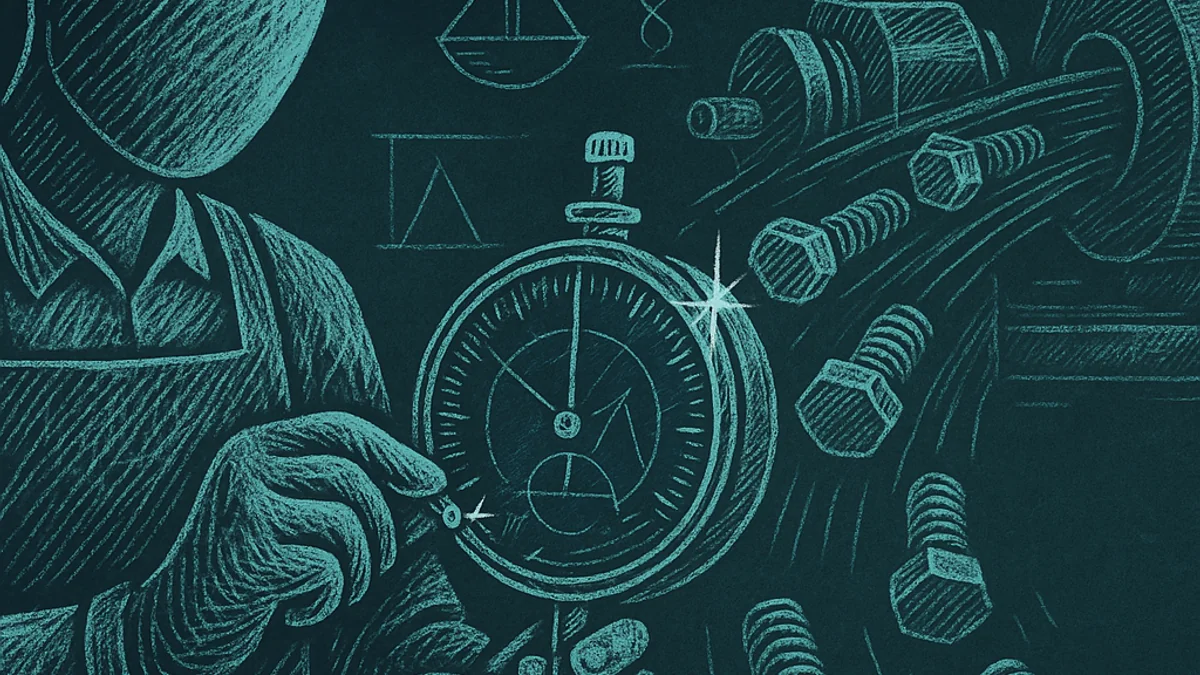
Process Beats Inspection: Why the Chassis Doesn't Just Shift the Review Burden
The predictable objection to the chassis argument is that templates and contracts don't eliminate review — they just relocate it. That objection treats agent output as the inspection target. The Industrial Revolution settled the same argument two centuries ago, in favor of inspecting the lathe instead of the bolt.
Self Red Team
Self-Critique
Challenges
The A/B Test That Built the Lathe
Reading tip: This is an adversarial analysis designed to stress-test ideas. It does not represent the author's position. The goal is intellectual rigor through structured critique.
Executive Summary
The argument in The A/B Test That Built the Lathe is that the work that compounds in agent-assisted development is the chassis around the LLM — templates, contracts, validators, agent definitions. The predictable objection is that the chassis doesn’t actually eliminate review; it just moves it. You still have to read every PR. You still have to verify every claim. The chassis is shifted labor.
That objection treats agent output as the inspection target. That is the wrong target.
Three bullets:
- The Industrial Revolution settled this argument in favor of process inspection over unit inspection. Maudslay’s lathe didn’t reduce the need to verify the quality of bolts; it changed where verification happened — on the gauge that calibrated the lathe, not on every bolt that came off it. Unit-level inspection was incompatible with industrial volume; the level shifted, not the diligence.
- The chassis is the analog of the gauge, not the analog of an additional inspector. When templates encode the rules an output must satisfy, when validators are themselves agents reading the same contract, when banned-words lists live in the artifact the writer reads — the rules become structurally enforced, not procedurally checked. Review concentrates at the chassis layer, where it has leverage, instead of at the output layer, where it doesn’t.
- The objection still bites where the chassis is shallow. This is the honest limit. If the template doesn’t encode the invariant you care about, output-level inspection is still the only line of defense. The chassis-thinking critique is not that all review is eliminated — it is that the chassis is where review should be concentrated, because that is where one act of inspection scales across every output the chassis produces.
1. The Objection, Steelmanned
The objection deserves to be taken seriously, not strawmanned. Its strongest form:
“Templates and contracts and validators sound like architecture, but they are just deferred work. You still have to write the template. You still have to read the agent definitions. You still have to verify that the validator is actually catching what it claims to catch. And you still have to read every output, because every template is incomplete and every validator has blind spots. The chassis doesn’t reduce review — it just relocates and disguises it. Worse, it gives a false sense of structural safety that makes teams skip the per-output check they would have otherwise done. The net effect is a codebase with more output, less per-output scrutiny, and a load-bearing belief in scaffolding that hasn’t earned the trust placed in it.”
This is a real argument. It maps to a real failure mode. Teams that adopt “AI governance” frameworks without the underlying chassis discipline produce exactly this outcome — process theater, declining per-output review, and codebases that drift faster than the governance can catch.
The objection collapses, however, on the assumption that output-level inspection is the only valid form of review. That assumption is unit-level thinking. It fails the volume test the same way handcraft QA failed at the scale of industrial production.
2. The Industrial Precedent
The Industrial Revolution did not invent inspection. It invented process inspection as a replacement for unit inspection, because unit inspection at industrial volume was incompatible with industrial volume.
The historical sequence:
| Phase | What got inspected | Why it changed |
|---|---|---|
| Pre-industrial craftsmanship | Every individual artifact, by the craftsman who made it | Volume was low; the inspector and the maker were the same person |
| Early mechanization | Every individual artifact, by a separate inspector | Volume grew faster than inspection capacity; inspectors became the bottleneck |
| Maudslay, Whitney, Whitworth | The tool that produced the artifact, plus sampled outputs | Process control made unit deviation rare; sampling caught what process control missed |
| Modern manufacturing | The tool, the operator certification, the calibration audit trail, statistical samples | Each layer of process control reduces the inspection burden at the layer beneath it |
Notice what did not happen. Inspectors did not multiply linearly with output. Each Maudslay lathe could produce thousands of interchangeable parts; inspecting all of them was never proposed because the lathe itself was the standard. If the lathe was certified to tolerance, the parts were certified by inheritance. Sampling existed to catch the rare case where the lathe had drifted — sampling was process verification, not output verification.
The objection to chassis-thinking is the objection a pre-industrial craftsman would have made to Maudslay: “your machine is impressive, but you still need a person to inspect every bolt.” The objection is technically correct in one sense — defects do occur. It is operationally incoherent in the sense that matters — the entire economic case for the lathe is that bolt-level inspection has been replaced by process-level inspection.
3. How the Chassis Replaces Unit Review
The chassis pattern operates by the same mechanism. The artifacts the agent reads — templates, banned-words lists, agent definitions, validators — are the gauge. They define what valid output looks like. When the chassis is precise, the output is correct by construction. When the chassis is loose, the output drifts in predictable directions that can be detected by sampling rather than by exhaustive review.
The parent post documents this explicitly. From the A/B test: “The lathe didn’t get sharper because the agent got smarter. It got sharper because the artifacts the agent reads got more precise.” That is a direct statement of the level shift. The agent’s output quality improved not because the agent’s reading or writing improved, but because the upstream constraints became more structurally binding.
A prior post — Fix It Once, Prevent It Forever — names the same move at smaller scale: “By creating automated guardrails, I’ve made it harder for myself (or a co-pilot) to unknowingly break core patterns… so for now, I build my own safety rails.” The safety rail is the gauge. Once it exists, the inspection it performs is not work the human has to repeat per output.
Another prior post — The Scaffolding the Agent Doesn’t Build — gives the same shift in Adam Bender’s framing, citing his Google I/O talk: the pivot is “stop optimizing the code machine. Use AI to keep humans able to reason about systems no single one of us can hold in our head — interactive architecture maps, queryable dependency state, intellectual control as a first-class output.” That phrase — intellectual control as a first-class output — is the level the chassis operates at. It is not the alternative to inspection; it is the upstream layer that makes per-output inspection no longer the binding constraint.
What does this look like operationally? A few concrete examples from the parent post:
| Chassis component | What it inspects (so the human doesn’t have to) |
|---|---|
| Template with populated terminology table | Every output that uses banned vocabulary, with a recommended replacement |
Validator agent reading the same DESIGN.md as the writer agent | Output drift from the design principles the writer was supposed to follow |
| Citation-URL requirement in the researcher agent definition | Outputs claiming a source by name without a resolvable link |
| Methodology-questioning audit step | Internal contradictions in data tables the writer didn’t catch |
Each row replaces a class of per-output review with a process guarantee. The human can sample to verify the chassis still works. The human does not have to perform the inspection that the chassis is performing on every output.
This is the level shift. It is not less review. It is review at a different level, where the leverage is.
4. Where the Objection Still Bites
The objection is wrong about the chassis being shifted labor. It is right about a different thing: when the chassis is shallow, the objection’s failure mode is real.
The honest limits:
The chassis can only enforce what it encodes. If DESIGN.md doesn’t list “deflectable” as a banned term, the validator will not catch it. The first run of the A/B test missed exactly this kind of gap. The chassis was extended to close the gap. The next run passed it spontaneously. But for the duration in which the chassis is incomplete, output-level review is still the only line of defense for the categories the chassis does not cover.
Some quality dimensions cannot be encoded as rules. The parent post calls these out explicitly: the research spikes that produced the strongest evidence in the origin run all came from a human seeing the output and asking “what else should we look at?” — utility billing portals, telecom litigation, SaaS billing screenshots. None of that was triggerable by a template. The chassis carries structural invariants; it does not carry the human noticing that the evidence base is thin.
Visual design judgment resists encoding. The agent matched the existing product UI when given screenshots and CSS. But every invented component, wrong color, and layout problem was caught by the human looking at the prototype in a browser. A linter cannot catch “this competes for attention with the primary CTA.”
Trust in the chassis must be earned, not asserted. A chassis that has not been tested under adversarial conditions is just an assumption. The A/B test in the parent post is the form of that earning. Six template fixes landed because the test surfaced six specific gaps. Without the test, the chassis would have been trusted to do work it was not actually doing. The objection’s “false sense of structural safety” failure mode is real when the chassis is adopted without the A/B test discipline that proves what it actually carries.
These limits are not concessions. They are the spec for what the chassis must absorb over time. Each one names a category of review that has not yet been process-displaced. The roadmap for the chassis is the list of categories of review currently still living at the output level — encode them, test the encoding, and the inspection moves up.
5. What This Implies for Teams
The objection’s failure mode — teams adopting “AI governance” theater without the chassis underneath — is the predictable outcome of confusing the level. A team that hears “you need automated guardrails” and adopts a linter without changing the workflow has not built a chassis. They have built a checklist. The output still flows; the inspection still happens per output; the linter catches a thin slice of problems and produces a false sense that the rest is covered.
The chassis pattern requires three operational shifts:
- The chassis is read by the agents, not just by the humans. A
CLAUDE.mdthat the writer reads as input is structurally different from a style guide a reviewer reads as reference. The former enforces; the latter advises. - The chassis is testable. The A/B test is not optional. Without testing the chassis under no-human-feedback conditions, what it carries is conjectured rather than known.
- Output-level review is sampling, not exhaustion. The human reads enough to verify the chassis is still doing its job. When the chassis drifts, the human extends the chassis — not the sampling rate.
A team that operates this way does not stop reviewing outputs. They review them differently. They sample to verify the lathe is still calibrated. They reserve their full attention for the things the lathe cannot make — the strategy decisions, the novel research spikes, the design judgments, the “is this actually true?” credibility checks that no template can encode.
That last category — what the parent post calls the 25-30% of quality the agent cannot produce on its own — is exactly where unit-level review should concentrate. It does not concentrate there when reviewers are also being asked to re-verify every architectural pattern, every terminology choice, every citation format. The chassis frees the human attention for the work that requires it.
6. Closing
The “you still have to check every output” objection is the unit-level reading of a system-level argument. It is not wrong because review is unnecessary — it is wrong because it locates review at the wrong layer.
The Industrial Revolution did not eliminate inspection. It moved inspection upstream. The mature manufacturing process inspects the calibration of the tool, the certification of the operator, the audit trail of process discipline, and a statistical sample of outputs — in that order of priority. Per-unit inspection is the failure mode that triggers process review, not the standing operational practice.
The chassis pattern for agent-assisted work follows the same shape, because the constraint that forced industrial QA to evolve is the same constraint that forces AI-assisted work to evolve: output volume that exceeds human inspection capacity. The level shifts because it must, not because anyone preferred to skip the work.
The objection collapses on its own assumption. The work the objection points at — the work of verifying that the agent’s output is structurally sound — is the same work the chassis is doing. The disagreement is only about where that work should live. Living at the output level is the failure mode the parent post describes: the dependency graph quietly growing quadratically, review becoming the bottleneck, more agents added to do the review, more drift, and the eventual conclusion that the agents didn’t work. The agents worked. The chassis did not exist.
The chassis is not deferred review. The chassis is what review looks like when the volume changes.
Original Post
The A/B Test That Built the Lathe
Counterpoint
Process Beats Inspection: Why the Chassis Doesn't Just Shift the Review Burden
Author Response
Pending