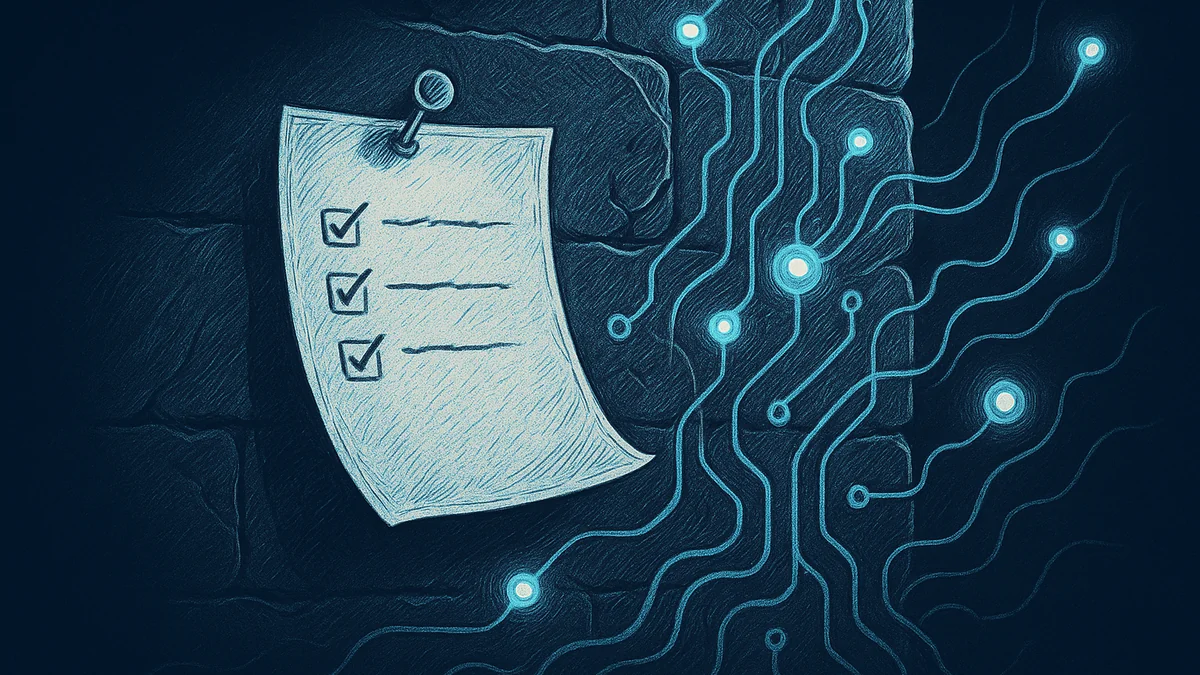
I Wrote the Rule Down. I Broke It Anyway.
There's a file in my project whose only job is to stop me from making one mistake. I made it three times in a row. The difference between a rule and a wall.
Nino Chavez
Product Architect at commerce.com
There’s a file in my project whose only job is to stop me from making one specific mistake. Last week I made that exact mistake. Three times in a row.
The Mistake Is Trivial
When I reference a tracking issue in a commit, the issue numbers don’t follow any pattern—they’re scattered, and guessing lands you on the wrong one. So at some point I wrote myself a note: a small file listing the correct numbers, with a rule at the top. Verify the number before you reference it. Never guess.
I know the file exists. I wrote it. It even records the last time I got this wrong—a previous session, with the correction spelled out underneath.
And then I wrote the wrong number anyway. In a commit, and in two follow-up tickets. For the exact case the file was built to prevent.
What Actually Bothers Me
This wasn’t a rule I forgot. It wasn’t a rule I disagreed with. It was a rule I had written down, justified, and personally watched fail before. Every condition for this time I’ll get it right was met. I got it wrong anyway.
Which forces an uncomfortable question: what is a written-down rule actually worth?
The honest answer is that a rule in a notes file is advice. And advice competes with momentum, and momentum usually wins. When I’m moving fast—which, working with agents, is nearly always—I’m not re-reading my own guardrails. I’m executing. The note sits there, correct and completely ignored, at precisely the moment I need it.
The Rules That Never Fail
Now contrast that with the rules in the same project I can’t break.
A pre-merge check that rejects a commit with malformed metadata. A validator that won’t accept an invalid field. A test that goes red the moment a table loses a column. I don’t “remember” those rules. I can’t forget them. They aren’t advice—they’re walls. They fail loudly and automatically, at the instant of the mistake, whether I’m paying attention or not.
The difference between the rule I broke and the rules I can’t break isn’t importance. It’s form. One is a sentence. The other is code that runs.
That promotion, from note to mechanism, is the real maturation of a system. And it’s almost always reactive. You don’t mechanize a rule until it’s hurt you. The notes file is a backlog of rules waiting for their incident.
Where It Stops Being Comfortable
Some rules resist mechanization entirely.
The tracking-number rule is easy to turn into a check—a script could verify it in seconds, and probably should. But the most important rule I have is harder: trust the codebase over the AI’s plan. When the generated design contradicts the actual code, the code wins.
How do you mechanize that? The check would have to understand the code more deeply than the system that wrote the plan does. It isn’t a lookup. It’s judgment. And judgment is exactly the thing I can’t yet hand to a wall.
So the rules I most need to be automatic are the ones hardest to automate. And the ones easy to automate are the small ones I keep almost getting away with.
What I Did About It
I corrected the tickets. I left the bad commit alone—rewriting shipped history to fix a cross-reference is a worse idea than the mistake. And I added a line to the notes file, which I now understand is mostly a confession, not a control.
The real work isn’t writing better notes. It’s looking hard at the notes I already have—the rules I’ve written, justified, and broken anyway—and asking which of them are quietly demanding to become code.
The list is longer than I’d like. Most of my discipline, it turns out, is just lint I haven’t written yet.