The Taste Gap
AI can produce endlessly. But it can't tell you what's good. That gap — between generation and judgment — might be the only thing that matters now.
Nino Chavez
Product Architect at commerce.com
Previous: The Identity Crisis of the Prompter
I ended the last post circling a word. Taste. The people who seem least rattled by the identity shift aren’t the best prompters or the fastest adopters — they’re the ones with the clearest sense of what good looks like.
But that observation left me with something unresolved. Because “have better taste” isn’t advice. It’s a bumper sticker. And I wanted to understand what’s actually inside that word.
So I started paying attention.
The Twelve Layouts
Something happened last week that crystallized this for me.
I asked an AI to generate twelve variations of a component layout. All twelve were valid. Syntactically correct. Responsive. Accessible, even. And not one of them was right.
Not broken. Not wrong. Just… flat. Like a meal where every ingredient is technically fresh but nobody seasoned anything.
This is different from the identity crisis I wrote about. That was about who we are when the making gets automated. This is about what happens next — the practical reality of living with abundant, competent, under-seasoned output.
The Bottleneck Moved
We’ve solved generation. That’s done. The bottleneck moved and most people haven’t noticed yet.
The bottleneck is taste.
Not “aesthetic preference” taste — not whether you like serif fonts or rounded corners. I mean the deeper thing. The ability to look at something functional and say this isn’t it without being able to fully articulate why. The instinct that fires before the reasoning catches up.
AI doesn’t have that instinct. It has patterns. It has statistical likelihood. It has “what usually comes next.” But it can’t feel the difference between a paragraph that lands and one that just… occupies space.
What Taste Actually Is
I’ve been trying to break this down for myself, and I keep landing on three components:
- Context sensitivity — knowing what this specific situation demands, not what works “in general”
- Negative space awareness — recognizing what to leave out, which is harder than knowing what to include
- Accumulated judgment — the residue of a thousand decisions you’ve already made, informing the next one without conscious effort
That last one is the killer. Because it’s not transferable. I can’t write a prompt that encodes twenty years of watching what works and what doesn’t. I can describe outcomes. I can show examples. But the weighting — the intuition that says “this example matters more than that one for this context” — that’s the gap.
The Seasoning Problem
Here’s an analogy that keeps working for me.
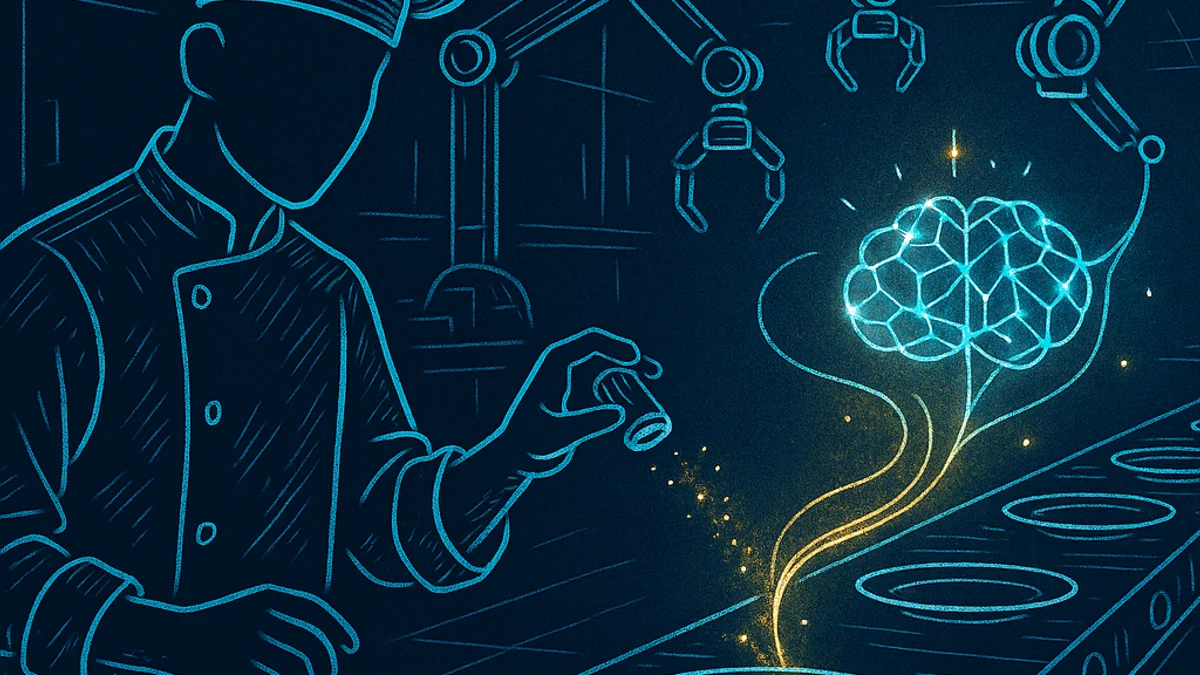
A commercial kitchen can produce volume. Consistent, reliable, scalable output. Every dish hits the spec. Temperature correct. Plating standardized. Nutritionally complete.
But seasoning — the pinch of salt that transforms a dish from adequate to memorable — that’s a human read. It depends on the specific batch of tomatoes. The humidity in the kitchen. Whether this is a Tuesday lunch crowd or a Saturday evening.
AI output has the same problem. It hits the spec. It meets the brief. It’s “correct.”
But it’s under-seasoned. And most people can feel it even when they can’t name it.
Where This Gets Uncomfortable
The uncomfortable part isn’t that AI lacks taste. It’s that most humans aren’t developing theirs either.
If the gap between generation and judgment is where value lives, then the question becomes: how deliberately are you cultivating your own taste? Not your ability to prompt. Not your ability to evaluate outputs against a rubric. Your taste.
The instinct that says “try again” when everything looks fine.
I catch myself skipping that step more than I’d like to admit. The output is good enough. It checks the boxes. Moving on feels productive. But “good enough” accumulates. And eventually you look up and realize everything you’ve shipped is adequate and nothing is distinctive.
The gap between “this works” and “this is right” is where taste lives. And that gap is getting easier to skip.
Building the Muscle
I don’t have a framework for this. What I have is a practice that’s been working:
- Reject the first good output. Not because it’s bad, but because accepting it too fast atrophies the judgment muscle
- Articulate the “why not.” Force yourself to explain what’s missing, even when it’s vague. Especially when it’s vague. The articulation is the training
- Study what you admire. Not to copy — to understand what makes it land. Reverse-engineer the seasoning
That last point matters more than the others. Taste isn’t born. It’s built through exposure to quality and honest reflection about why it works.
The Quiet Crisis
Here’s what concerns me most: we’re entering an era where the people who most need to develop taste are the ones most likely to outsource it.
If you’ve never had to produce from scratch — never wrestled with a blank page, never made a bad decision and lived with it, never built something ugly and figured out why it was ugly — then evaluating AI output becomes a surface-level exercise. You can check for errors. You can verify facts. But you can’t feel the difference between competent and compelling.
And that difference is everything.
The taste gap isn’t a temporary problem that better models will solve. Better models will make it worse. More output, more polish, more “correct” — and the same human bottleneck sitting between generated and good.
But here’s what’s been nagging me as I’ve sat with this. Taste alone might not be enough either. Knowing what’s good is one thing. Knowing what’s good for this specific situation, this audience, this moment — that’s a different skill entirely.
The food metaphors keep pulling me somewhere. If taste makes you a critic, what makes you something more useful than that?