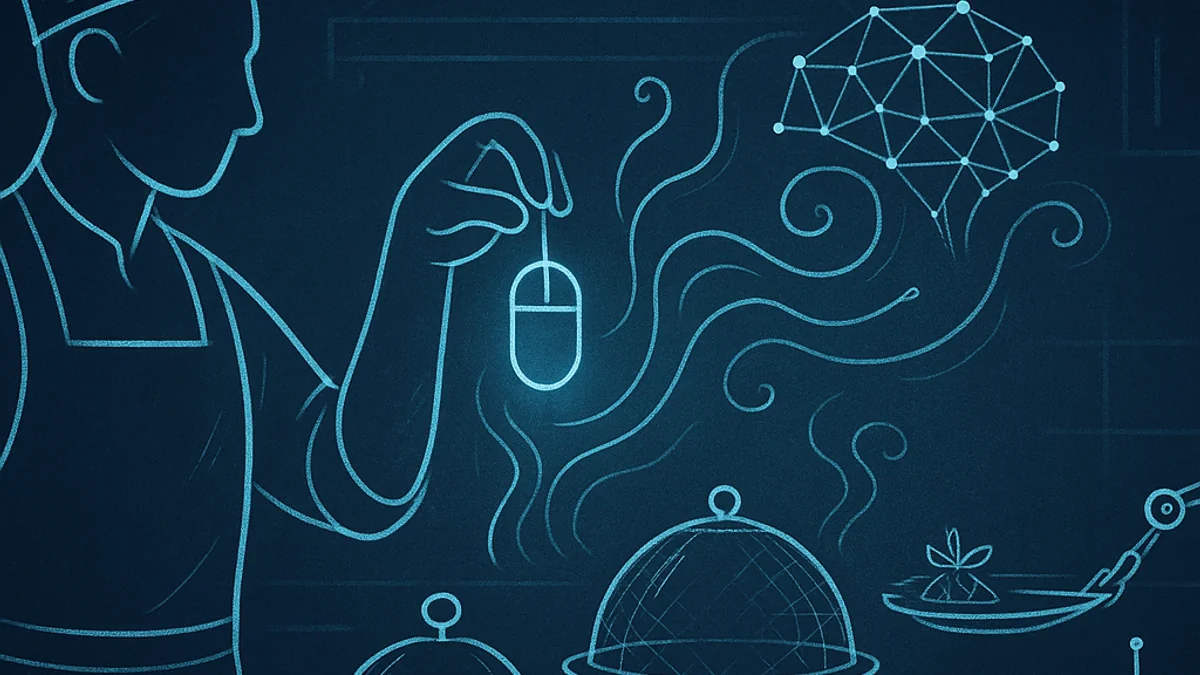
The Identity Crisis of the Prompter
We keep reaching for craft metaphors — chef, artisan, architect — because 'person who types instructions' doesn't feel like enough. Why?
Nino Chavez
Product Architect at commerce.com
I typed four words into a prompt last Tuesday and got back something that would’ve taken me a full day to write from scratch.
My first reaction wasn’t relief. It was a weird, low-grade vertigo. Like the floor shifted two inches to the left and nobody else noticed.
Because if four words can replace a day of work — what was the day of work, exactly?
The Metaphor Problem
Watch how people talk about prompting and you’ll see it immediately. Nobody wants to call it what it is.
We say prompt engineering. We say AI whisperer. We say orchestrator. We reach for words like craft and artisan and architect.
The culinary metaphors are everywhere lately. We’re “chefs” composing dishes. We’re “sommeliers” with refined palates. We’re curating ingredients, balancing flavors, plating with intention.
And I get it. I’ve used these metaphors myself. They feel better than the alternative, which is: I typed a sentence and a machine did the thing.
Why It Stings
Here’s what I think is actually happening underneath all the metaphor-reaching.
We’ve built identities around making things. The act of creation — writing code, designing interfaces, crafting prose — wasn’t just how we produced value. It was how we understood ourselves. “I’m a developer.” “I’m a designer.” “I’m a writer.” These aren’t job descriptions. They’re identity statements.
When the making gets automated, the identity doesn’t just shift. It destabilizes.
So we tell ourselves stories. Prompting is an art. It requires skill. There’s a technique to it. And all of that is partially true — but the intensity of the claim reveals the anxiety underneath.
The Honest Inventory
Let me try to be straight about what prompting actually involves, at least in my experience:
- Knowing what you want (harder than it sounds)
- Knowing how to describe it precisely
- Recognizing when the output misses the mark
- Iterating with enough direction to close the gap
That’s real. That’s not nothing. But it’s also not making. It’s closer to directing. Or commissioning. Or — and this is the one that really needles — managing.
The irony doesn’t escape me. I spent years learning to write, to code, to design. Now the most valuable version of those skills might be the ability to evaluate output rather than produce it.
That’s a manager’s job. And I’ve always been slightly suspicious of people whose primary skill is judgment without production.
The Discomfort of the Middle
The identity crisis hits hardest in the middle — people with enough skill to know what good looks like, but who are increasingly using AI to produce it.
If you’re a beginner, there’s no crisis. AI is just a powerful tool. You’re learning.
If you’re an expert at the top of your field, the crisis is manageable. Your taste and judgment are so refined that the gap between what AI produces and what you’d accept is obvious. You’re clearly adding value.
But in the middle? Where most of us live? The gap is narrow enough to be uncomfortable. The AI output is almost what you’d have made. Close enough that the delta feels trivial. And if the delta is trivial, then the identity built on that delta starts to wobble.
The crisis isn’t that AI can do what we do. It’s that the gap between what it produces and what we’d produce is narrow enough to question whether the gap matters.
What I’m Actually Wrestling With
I don’t think this resolves cleanly. But here’s where my thinking is right now.
The metaphors aren’t wrong — they’re aspirational. When someone calls themselves a chef instead of a prompter, they’re describing who they want to be in this new arrangement. Someone whose judgment and taste are the essential ingredient. Someone who’s more than a relay between intention and machine.
The question is whether the aspiration matches reality.
For some people, it does. Their prompting reflects deep domain knowledge, refined taste, and genuine creative direction. The output couldn’t exist without their specific contribution.
For others — and I include myself some days — it’s closer to selecting from a menu than cooking a meal. And being honest about which mode I’m in on any given day matters more than picking the right metaphor.
The Thing Nobody Wants to Say
Maybe “prompter” doesn’t need to feel like enough. Maybe we’re allowed to be in an awkward transition where the old identity doesn’t fit and the new one hasn’t formed yet.
Every time a major tool shift happens, there’s a period where people don’t know what to call themselves. Typesetters became designers. Webmasters became developers. The new title always felt insufficient at first.
We’re in that gap right now. And the discomfort of it — the reaching for metaphors, the inflating of “prompt engineering” into something grander than it sometimes is — that’s just what transitions feel like from the inside.
Messy. Undignified. Real.
I don’t know what we’ll call ourselves in five years. Probably something that sounds obvious in retrospect and ridiculous right now. But I’m less interested in finding the right title than in doing the honest work of figuring out what I actually contribute when the machine handles the production.
That word keeps surfacing, though. Taste. The people who seem least rattled by this shift are the ones with the strongest sense of what good looks like. Their identity isn’t built on making — it’s built on knowing.
Which raises a harder question: what is taste, exactly? And what happens when we stop building it?