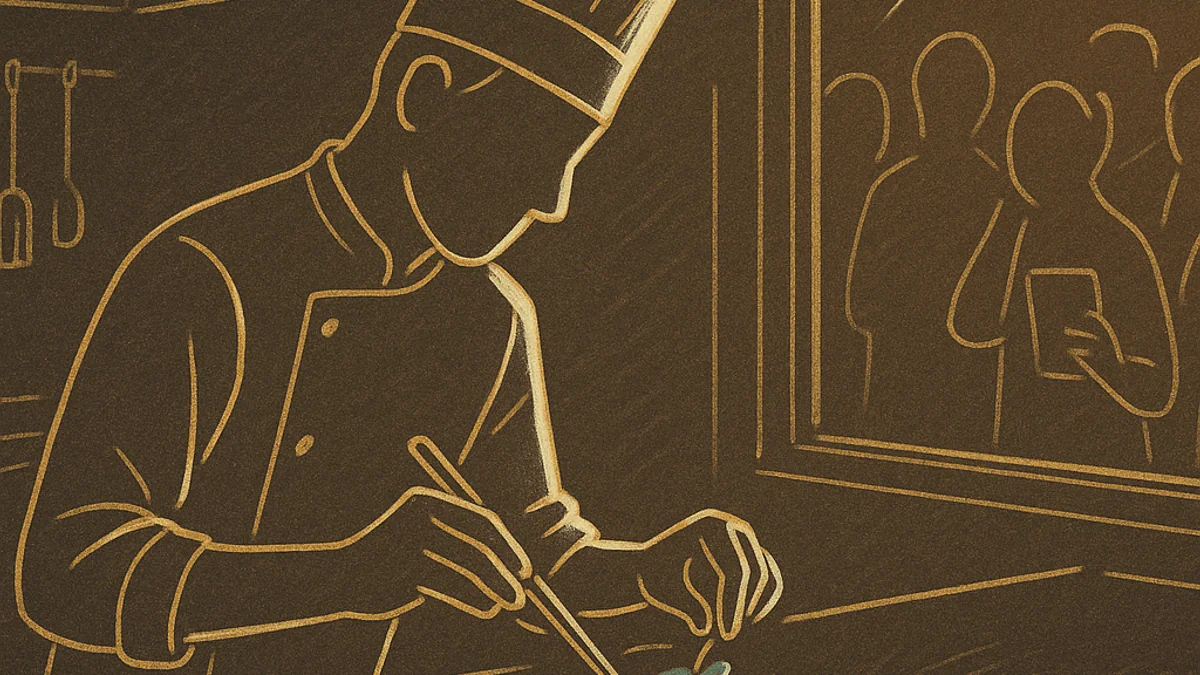
Open Kitchen
I went looking for other cooks and found closed kitchens — not hostile, just complete. The Bear turned out to be the show that named what's actually missing in agent-assisted work, and what it might cost me to build the alternative.
Nino Chavez
Product Architect at commerce.com
I’ve been looking for other cooks.
Not engineers — I know plenty of engineers. Cooks. People who run the kind of kitchen I run now: agents working the line, the human standing at the pass, deciding what goes out and what gets sent back. Products leaving the window that one person could never have plated alone.
They exist. I catch glimpses — a commit history here, a conference talk there. And every one of them already has a kitchen. Their own techniques, their own recipes, a setup tuned over hundreds of sessions. The door isn’t locked, exactly.
It’s just not open. There’s nothing for a visitor to walk into.
The Recipes Stay in the Kitchen
I don’t think it’s gatekeeping.
A working setup for agent-assisted development is intensely personal. Standing instructions, hooks, review gates, the accumulated scar tissue of every session that went sideways. Half of it is undocumented because it doesn’t need documenting — the cook is standing right there.
Letting someone into that costs more than cooking alone. You’d have to explain the why behind every station. So nobody does.
Every kitchen I admire is a kitchen of one.
What Cooking Has That We Don’t
Professional cooking solved this problem a long time ago, and The Bear — set in Chicago, where I’ve spent my whole career — is practically a documentary about the solution.
There’s the brigade: a standard layout for a kitchen, so a cook can walk into a new one and know where they stand. There’s the cookbook: technique written down so it survives the chef. And there’s the stage — the tradition of working someone else’s line, unpaid, just to absorb how they do it.
Carmy exists because of those institutions. He staged in the best kitchens in the world, and when he inherited a sandwich shop, he carried the system in with him. The whole first season is one long technique transfer: brigade discipline arriving at a place that ran on chaos.
The episode that gets me is “Forks.” Richie — the loudest resister, the guy with the most invested in the old way — gets sent to stage at a fine-dining restaurant. A week of polishing forks. And it converts him. Not an argument, not a memo.
A kitchen that let him in.
Agent-assisted development is maybe three years old. It has no brigade, no stage culture, and barely any cookbooks. Everyone is self-taught. Everyone cooks alone.
So Open the Restaurant
If you can’t get a station in anyone else’s kitchen, the remaining move is to open your own — and run it with the dining room facing the line.
I didn’t plan it as a strategy. But looking at what actually shipped this year, that’s what it adds up to.
The meals are public: a tournament platform running live events, a photography portfolio serving twenty thousand images. Real products, real users, cooked by one person with agents on the line.
The cookbook is published: Blueprint, the delivery methodology I pulled out of those builds — research feeds the strategy docs, the docs plan the prototype, the prototype validates the plan — written down and shipped as a CLI so another team can run the method without me standing at the pass.
And the cooking is narrated: a couple hundred essays on what worked and what burned.
Eat the meals. Learn the recipes. Take a station. Three ways in — the point is that there’s a door.
One cook has already walked through it. A colleague picked up the method for a real client build — the first service this kitchen ran that wasn’t mine. One data point, not a movement. But it’s the difference between a theory about open kitchens and a restaurant with a second person on the line.
The Carmy Problem
Here’s where the analogy stops flattering me.
The Bear is not a show about a chef who opens a restaurant and graciously lets people in. It’s a show about a chef who opens his own place and becomes the closed door. Non-negotiables taped to the wall. A menu that changes nightly because only his standard counts. And the image the whole series pivots on: Carmy locked inside his own walk-in on opening night — while the kitchen runs better without him.
That’s the honest risk of opening your own kitchen because nobody let you into theirs. You don’t automatically become open. You become the chef.
A methodology that only produces good meals when I’m working the pass isn’t a methodology. It’s my cooking with extra steps.
Blueprint already carries a rule I wrote for the agents: if the agent struggles, that’s not the agent’s failure — it’s a capability the system hasn’t built yet. Fix the system, not the cook.
I’m trying to hold myself to the same standard from the other side of the pass. If a cook walks in and can’t run a station without me hovering, that’s not their gap. It’s mine.
The Chef Nobody Watches
There’s a character The Bear never names, standing behind every episode.
The brigade Carmy runs — the stations, the hierarchy, the “yes, chef” — isn’t ambient kitchen tradition. It’s one chef’s published system. Auguste Escoffier wrote it down in 1903, and Le Guide Culinaire turned his kitchen’s practice into every kitchen’s practice. Cooks who never met him, in cities he never saw, are running his system tonight.
Escoffier doesn’t make good television. Nobody builds a show around a man codifying mother sauces. But he marks the difference between the two things a chef can leave behind: a restaurant, which dies with its kitchen, and a method, which doesn’t need you in the building.
A restaurant proves you can cook. A method survives you. If the open kitchen earns anything, I want it to be the second thing.
What Would Prove It
Not traffic. Not stars. Not even the meals going out the window — those only prove I can cook.
The open kitchen is proven the first time someone cooks a dish I didn’t write. A recipe added to the book that I have to learn. A correction flowing the other direction across the pass.
I don’t know yet whether anyone wants to cook here. But for the first time, that’s a question someone other than me gets to answer.