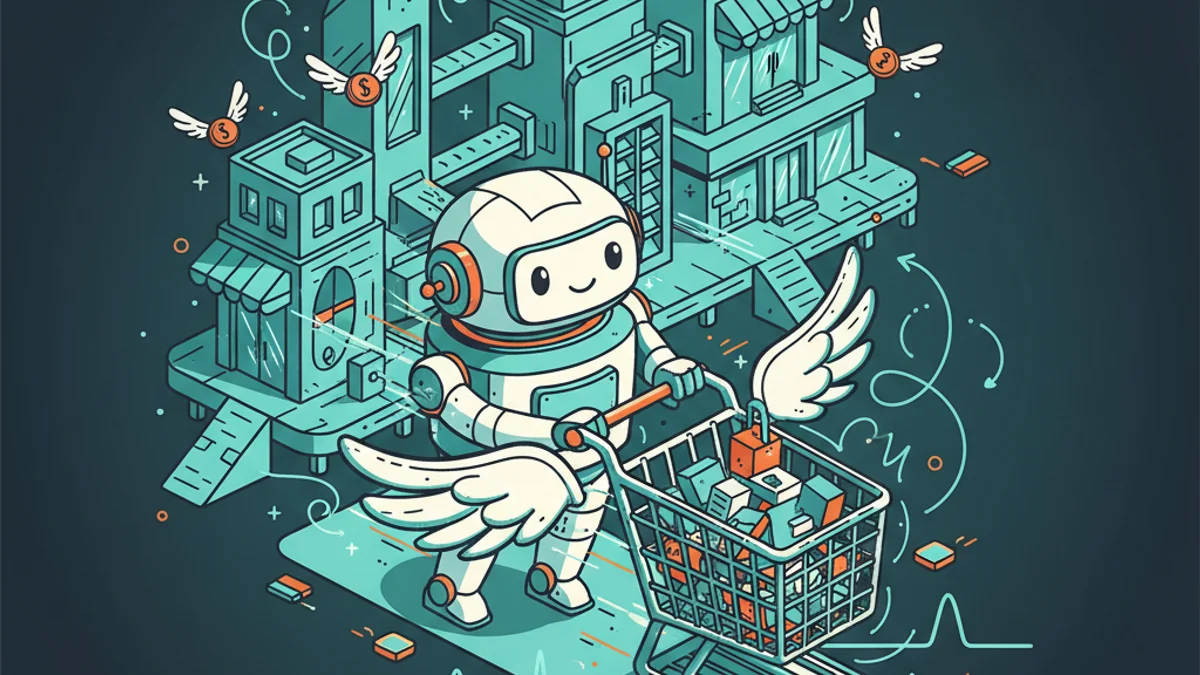
The Infinite Concierge: Why Agentic Shopping Is Just Old School Merchandising on New School Rails
Agentic shopping doesn't change why we buy. It radically changes the cost of discovery and the precision of the pitch. The game is the same. The speed of the players has changed everything.
Nino Chavez
Product Architect at commerce.com
It’s mid-November. You’ve got seventeen people on your holiday gift list. You open your phone and start scrolling.
Tab one: “Best gifts for Dad 2024.” Tab two: “Top 10 Air Fryers Under $150.” Tab three: You forgot what you were looking for.
Two hours later, you’ve watched six comparison videos, read fourteen Amazon reviews, and added three things to your cart that you still haven’t bought. Decision fatigue is real. Choice overload is real. And you’re not even halfway through the list.
Now imagine this instead:
You open a simple interface. You say: “I need a gift for my dad. He loves grilling, has a bad back, and hates gadgets that need apps.”
Three seconds later, you’re looking at two options. One’s a self-cleaning grill brush with an ergonomic handle. The other’s a wireless meat thermometer that pairs with nothing. Both under $50. Both have 4.7+ stars. Both ship in time.
You pick one. Done. Next person on the list.
That’s the difference. Not a new psychology of buying. A new cost of discovery.
This is what agentic shopping promises. But here’s the question most people aren’t asking:
Is this innovation—or just optimization so extreme it feels like innovation?
Part 1: The First Principles (The “Old World”)
Before algorithms, before SKUs lived in databases, the “Merchant Prince” relied on immutable laws of human behavior.
If you walked into a high-end department store in 1950, you encountered one of two experiences—depending on what kind of shopper you were.
The Two Shopper Archetypes
The Hunter (Deal/Utility): They know exactly what they want. Their friction is Price and Availability.
Traditional Solution: The end-cap display. The loss leader. The coupon circular. “Stack ‘em high, watch ‘em fly.”
The Gatherer (Assortment/Experience): They don’t know what they want yet. Their friction is Curation and Inspiration.
Traditional Solution: The treasure hunt. Visual merchandising. The boutique window display that tells a story. Think TJ Maxx. Think the carefully arranged mannequin that makes you feel something.
These aren’t new customer segments invented by data scientists. They’re ancient. Hardwired. Universal.
The “Clerk” as the Algorithm
In 1950, if you walked into that department store, a skilled clerk performed the ultimate algorithm—manually:
- Qualification: “Is this for an occasion?” (Identifying the Why)
- Curation: “I have three items in the back that would fit you perfectly.” (Filtering the Assortment)
- Closing: “It feels just like the one you bought last year, but in this season’s color.” (Trust/Consistency)
The clerk wasn’t guessing. They knew. They remembered. They curated.
The First Principle: Conversion is simply the result of reducing the gap between Customer Intent and Available Inventory.
That’s it. That’s the whole game.
The merchant who closes that gap fastest—with the least friction, the most trust, and the clearest path to “yes”—wins.
Part 2: The Agentic Innovation (The “New World”)
Here’s the uncomfortable truth:
Agentic shopping does not invent a new psychology.
It actually marks a return to the “Personal Clerk”—but at a scale and speed previously impossible.
In the Web 2.0 era (Search & Scroll), we forced the customer to be their own clerk. They had to filter. They had to compare. They had to do the math on shipping, availability, and total cost.
Agentic shopping returns the labor to the merchant (or the agent).
Accelerating Discovery
You mentioned earlier: “I can identify my customer faster, deeper, and broader.”
Here’s how the agent applies first principles:
For the Deal Hunter: The agent doesn’t just find the lowest price. It calculates Total Landed Cost (shipping, time, reliability) instantly. It satisfies the Price/Utility drive without the user doing the math.
For the Assortment Browser: This is where it gets interesting. The agent doesn’t show you 10,000 items (The Endless Aisle). It curates a Micro-Assortment of 2-3 items based on your history of Trust, Brand Affinity, and Aesthetics.
It doesn’t drown you in choice. It narrows choice to the options most likely to satisfy.
Just-In-Time Merchandising
This is the true shift. It isn’t about changing the product. It’s about changing the Context.
If an agent knows:
- The user is price-sensitive (Deal Hunter)
- The user loves high-quality leather (Quality/Trust)
- It’s two weeks before Christmas (Urgency)
The agent autonomously constructs a “Storefront” for that one person, at that one moment. It surfaces a mid-range leather bag that’s currently 20% off, ships in 3 days, and matches their aesthetic from previous purchases.
It creates a “Sale” that only exists for that user, at that moment.
Not because the merchant manually programmed it. Because the agent inferred it—based on signals, context, and constraints.
Part 3: The Verdict—Innovation vs. Optimization?
You asked: Is this just a new way to reach and convert customers faster?
It is optimization so extreme it feels like innovation.
Here’s why that matters.
It Solves the Paradox of Choice
Traditional Merchandising: “Here is everything we have, arranged by category. Good luck.”
Agentic Merchandising: “Here is the one thing you actually want—even if you didn’t know it yet.”
The psychology hasn’t changed. Humans still buy based on:
- Experience (Does this feel good?)
- Brand (Do I trust this?)
- Quality (Will this last?)
- Trust (Have they been right before?)
- Uniqueness (Does this say something about me?)
But the cost of surfacing the right answer has collapsed.
The Just-In-Time Conversion Probability
You can absolutely lean on agentic processes to surface products based on Conversion Probability Metrics.
Instead of asking: “What demographics imply this user will buy?” The agent asks: “What specific combination of First Principles drives this specific user?”
- User A is driven by Social Proof. (The agent surfaces: “This is the #1 gift for Dads in 2024.”)
- User B is driven by Scarcity. (The agent surfaces: “Only 2 units left at this price.”)
- User C is driven by Utility. (The agent surfaces: “This replaces 3 tools you currently own.”)
Same product. Different pitch. Different user. Different moment.
The agent doesn’t change what people want. It changes how fast they find it.
The Bottom Line
Agentic shopping strips away the digital noise—banner ads, pop-ups, endless scrolling, decision paralysis—and returns us to the oldest form of commerce:
A trusted advisor handing you exactly what you need.
The “Innovation” is that we can now do this for 100 million people simultaneously, in real-time, with context that updates every session.
The game is the same. The speed of the players has changed everything.
So Where Does This Leave Us?
If you’re building in this space—whether you’re a brand, a platform, or an agent developer—the question isn’t:
“How do I invent a new reason for people to buy?”
The question is:
“How do I close the gap between intent and inventory faster, with more trust, and less friction than anyone else?”
That’s it. That’s the whole game.
And agents? They’re just the fastest clerks we’ve ever had.
Here’s where I’ve landed—for now:
Agentic shopping is not a revolution in human psychology. It’s a renaissance of human-centered commerce. We’re returning to the personal touch, the trusted recommendation, the curated experience—at infinite scale.
The Hunters still hunt. The Gatherers still gather. The merchants still curate.
The only difference? The concierge never sleeps. And they remember everything.